AI Business Command Centers in 2026: Security, NIS2, and Risks

Piero Bassa
Founder & CEO
 Claude
  Perplexity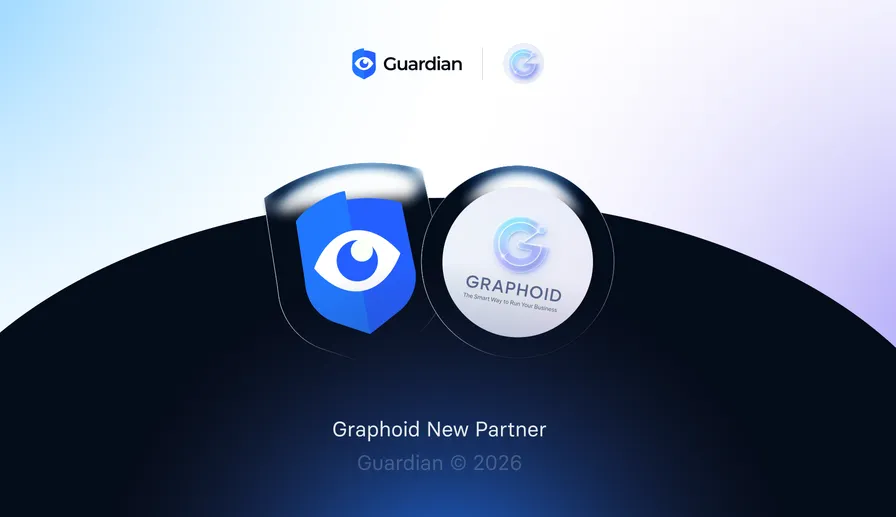
The mid-market software stack used to be a patchwork: a CRM here, a ticketing tool there, an HRIS, a chat app, a BI tool, and a few spreadsheets holding it all together. That model is breaking down. Companies in India and the EU are consolidating onto unified operational platforms, and AI is finally good enough to do the routing, flagging, and escalation that used to require dedicated coordinators.
This is the context for the partnership between GuardianStack and Graphoid, an AI-powered business command center serving mid-market enterprises across India and the EU, with a focused presence in Poland.
A partnership for AI-powered operations across India and the EU
Graphoid delivers an operational layer that unifies role-based dashboards, CRM, ticketing, HR tracking, internal communications, and operational analytics. An AI layer sits on top, handling intelligent task routing, anomaly flagging, automated escalation, and predictive workload distribution. The platform is delivered as SaaS, with hybrid deployment available for customers that require data residency or on-premise components.
GuardianStack brings device intelligence and fraud detection delivered via API. The two capabilities sit at different layers of the same problem: Graphoid runs the operational platform, GuardianStack secures the portals through which customers, employees, and partners access it.
The partnership focuses on mid-market enterprises in India and the EU that need enterprise-grade operational intelligence and enterprise-grade security, without the overhead of legacy ERP or large in-house security teams.
What an AI business command center actually does
The phrase “command center” gets used loosely. To understand why a platform like Graphoid changes the security model, it helps to be specific about what it consolidates.
Unified operational layer
In a typical mid-market firm, the same operational event (a customer ticket, a missed SLA, a new hire onboarding step) shows up in three or four different tools, each owned by a different team. Information gets lost in the seams.
A unified platform turns those seams into a single record. The same ticket carries the customer context from the CRM, the ownership from HR, the escalation history from internal comms, and the workload signal from operational analytics. Decisions get made faster because the people making them can finally see the full picture.
Vertical-aware architecture
Generic SaaS forces every customer into the same workflow. That works for horizontal categories like email or storage, but it fails fast in operations, where the right workflow for a healthcare clinic is different from the right workflow for an HVAC contractor or an IT managed services firm.
Graphoid’s vertical-aware architecture adjusts to the customer’s industry. Facility management, healthcare, HVAC, and IT managed services each get workflow logic shaped to how those businesses actually run. The customer is not bent to fit the platform.
AI on top of operations
Once operations are unified, AI can do useful work on top. Intelligent task routing assigns work to the right person based on availability, skill, and workload. Anomaly flagging catches unusual patterns in operational data before they turn into incidents. Automated escalation triggers handle the cases where someone misses a deadline. Predictive workload distribution smooths peaks before they become bottlenecks.
The net effect is fewer hours spent coordinating and more spent deciding. For mid-market firms running lean, that ratio is the whole game.
The consolidation paradox: more value, more concentrated risk
Unifying operations is the right move. It also concentrates risk in a way that fragmented tooling never did.
In a fragmented stack, an attacker who steals a CRM password gets the CRM. To reach HR, they need a separate compromise. To reach ticketing, another. The blast radius of any one credential is bounded by the silos.
In a unified stack, a single admin credential can reach CRM data, HR records, ticketing history, communications, and operational analytics at once. The same property that makes the platform valuable to legitimate users (everything in one place) makes it valuable to attackers.
This is not an argument against consolidation. It is an argument for treating the portal layer as a first-class security surface, on par with the endpoint and network layers most security programs already cover.
Where attacks land on operational platforms
The most common attacks on operational SaaS platforms do not involve exotic exploits. They target identity, and they happen at the login or admin portal.
Account takeover on admin portals
Account takeover starts with credentials stolen elsewhere. Phishing, third-party data breaches, infostealer malware on a personal laptop. The attacker takes the username and password and tries them on every business tool the victim uses, including the operational platform.
If the platform relies only on passwords plus SMS-based MFA, this often works. SIM swap and social engineering bypass SMS MFA reliably enough that determined attackers treat it as a speed bump, not a wall.
The defense is to identify the device making the login attempt. A familiar device used from a consistent geography is a trust signal. An unfamiliar device, especially one with hallmarks of automation or emulation, is a risk signal that should trigger a step-up challenge or block.
Multi-accounting and trial abuse
Operational platforms typically offer free tiers or trial periods. Both attract multi-accounting: the same user, or the same group, creating multiple accounts to extend free usage, abuse referral bonuses, or test exploits without exposing their real identity.
Email-based detection rarely works (disposable addresses, plus-aliases). IP-based detection rarely works (residential proxies). Device-based detection works because creating a new device profile is meaningfully harder than creating a new email or rotating an IP.
Scraping of operational dashboards
Competitors and intermediaries use bots to scrape operational dashboards. Pricing data, vendor lists, capacity signals, anonymized but inferable customer information. Modern scrapers run on real browsers behind residential proxies, defeating the rate limits and IP blocks that worked a decade ago.
Stopping them requires identifying the device behind the browser, not the IP behind the connection. That is the same primitive that stops account takeover, applied to read-only endpoints.
NIS2, data residency, and hybrid deployment
Operational platforms run sensitive data: customer records, employee information, vendor contracts, performance metrics. Where that data lives, who can access it, and how access is proven all matter for compliance.
NIS2 applies to in-scope companies running essential or important services on these platforms. Article 21 requires demonstrable controls on access, incident handling, and supply chain security. The platform vendor is part of the supply chain, and the customer is responsible for proving the vendor meets equivalent requirements. We covered this mapping in our NIS2 compliance checklist.
Hybrid deployment matters here. Some industries (healthcare, public sector, regulated finance) require data residency in a specific country, or a mix of cloud and on-premise components. Graphoid’s hybrid model accommodates this without forcing customers into either a pure cloud or a pure on-premise box. GuardianStack’s API model fits both: it runs as a service the customer’s portal calls, regardless of whether the portal is hosted in cloud, on-premise, or split between the two.
How GuardianStack secures the portal layer
GuardianStack is a device intelligence and fraud detection platform delivered via API. The integration is designed to be invisible to the legitimate user and fast for the developer to ship.
The pattern is consistent across login, signup, admin actions, and sensitive workflows:
- A lightweight JavaScript SDK on the page collects 70+ device and browser signals client-side.
- The backend calls the GuardianStack API to retrieve a risk score before completing the action.
- The application makes a risk-based decision: allow, challenge with a step-up, or block.
- Events are logged and can be exported as evidence for NIS2 or similar audits.
Two integration patterns cover most operational platform needs:
- Account takeover prevention on admin and customer logins, verifying every authentication comes from a trusted device.
- New account fraud prevention on signup and trial flows, blocking fake accounts, multi-accounting, and identity-level abuse.
For Graphoid customers operating in NIS2-regulated sectors, the GuardianStack signal also serves as auditable evidence of two Article 21 measures: access control and continuous authentication.
Concrete initiatives from the partnership
The collaboration translates into a set of joint initiatives for mid-market companies in India and the EU:
- Pre-integrated security layer for Graphoid customers that want device intelligence on their login, admin, and trial flows without building the integration from scratch.
- Shared playbooks mapping operational platform security to NIS2 Article 21 measures, with concrete artifacts for audit prep.
- Joint research on attack patterns observed across operational SaaS platforms in regulated industries.
- Webinars for IT, operations, and security leaders in Poland, India, and the broader EU mid-market.
- Coordinated support for customers running both Graphoid and GuardianStack, with unified reporting and incident handling.
A look ahead: operational intelligence and operational security
The next decade of mid-market software is consolidation: fewer point tools, more unified operational platforms with AI doing the coordination work that used to require headcount. That trend is already visible in India and in the EU, especially in countries like Poland where mid-market firms are catching up to enterprise tooling fast.
Consolidation creates value. It also creates a new security surface that the legacy security stack does not cover. Endpoint and network tools were not built to watch the admin portal of an operational platform. Identity providers see authentication events, but not the device behind them.
The partnership between GuardianStack and Graphoid puts both pieces in place: a unified operational platform with vertical-aware AI, and a device intelligence layer that secures every portal where users land. Mid-market companies in India and the EU get the operational uplift and the security posture in one move, instead of choosing between them.
If you run operations on a unified platform, or are evaluating one, this is the moment to think about the portal layer as a first-class security surface. The blast radius of consolidation is real, and so is the defense.
Try GuardianStack for free or talk to our team to see how device intelligence can be layered onto your operational platform.
Frequently asked questions
What is an AI business command center?
How does Graphoid differ from traditional ERP systems?
What security risks come with consolidating business operations into one platform?
Does NIS2 apply to operational SaaS platforms?
How does device intelligence protect AI business platforms?

Related articles
· 10 min read
Cybersecurity in Logistics 2026: Risks, NIS2, Fraud Detection
Logistics is a top target for ransomware and digital fraud. Protect WMS, TMS and ERP with device intelligence, NIS2 compliance and fraud detection.
· 12 min read
NIS2 Compliance Checklist: 10 Measures You Need in 2026
A practical NIS2 compliance checklist mapping Article 21's 10 cybersecurity measures to concrete actions. Includes audit preparation and reporting timelines.
· 11 min read
NIS2 for SaaS Companies: Who's in Scope and How to Comply
SaaS companies with 50+ employees or EUR 10M+ revenue are in NIS2's scope. Learn what's required, which sectors are affected, and how to prepare.